Pope Leo XIV urged Argentina’s leaders to judge economic policy by its impact on workers, families and people facing hardship, while supporting opportunity and private enterprise.
A clash over what the economy is for
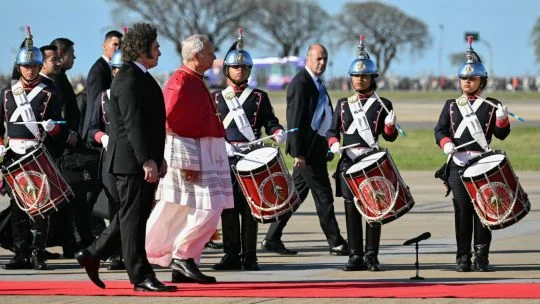
Pope Leo XIV’s first address in Argentina put the human cost of economic policy at the centre of his meeting with President Javier Milei. Unemployment, shrinking purchasing power and worsening social conditions were not side issues in his speech; they were the test by which he asked leaders to judge the country’s economic course.
At Palacio Libertad, Milei had just defended austerity and his effort to curb inflation by invoking the School of Salamanca, the Ten Commandments and Christian social teaching. He framed fiscal adjustment as a sacrifice by the present generation that could protect future Argentines, arguing that policy should serve society over time rather than favour one group in the moment. His account of the “common good” was “intertemporal general equilibrium”: a macroeconomic calculation meant to balance present and future interests.
Leo shifted the argument from that long horizon to the pressures people face now. The point carries weight in a country with strong Catholic beliefs, where the Pope speaks both as head of the Vatican City State and as the Church’s spiritual leader. He had not heard Milei’s speech beforehand, but his call to use natural resources for local communities challenged a central part of the government’s agenda all the same.
Work that still doesn’t cover the bills
“The common good served by those in authority must also be felt in the concrete conditions of everyday life,” Leo told Cabinet members and political representatives. He described a country where holding a job can still leave people below the poverty line. That’s a pointed measure of the gap between employment and economic security.
He spoke of work as a source of family income, personal development and participation in national life, recognising workers in rural and urban settings, from workshops and schools to hospitals, as well as business owners and people caring for their households. Then he named those under greatest strain: families living with uncertainty, jobseekers, older people who had spent years contributing to society, and workers whose wages still don’t meet household needs.
His line was blunt: “The economy must serve the person, not the person serve the economy.” That’s a direct challenge to any market-first account that treats hardship as an acceptable cost of adjustment.
Private enterprise, with a public obligation
Leo did not reject business or wealth creation. He urged leaders to support private initiative and expand opportunity, including for people facing the steepest barriers. But he also argued that public authority has a duty to serve the whole community, exercise power prudently and recognise its limits.
The contrast was especially clear in the leaders’ use of biblical imagery. Milei compared his programme to a house built on rock, invoking the parable of the two foundations. Leo answered with a different emphasis: authority reaches its highest purpose through service. The exchange exposed a real disagreement over how to judge policy—by the strength of its economic foundations, or by who benefits from them.
Education and scientific research sharpened that divide. Both have been affected by Milei government budget cuts, while Leo tied Argentina’s future to support for classrooms, vocational training, universities and public and private research centres.
Young people, education and technology
Argentina has abundant human resources, Leo said, but that advantage depends on whether young people can build their lives at home. He urged the country to ask why its young people feel they must leave to pursue their ambitions. The data in this speech doesn’t explain how many are leaving or why; the Pope’s warning was about the choices a country’s young people are being forced to make.
Leo also pointed to Argentina’s history of widening access to education, which has helped generations develop their skills and contribute across many professions. He called for stronger education, job training, universities and research so young people can plan their futures freely in Argentina.
Technology, he argued, needs ethical judgment to keep pace with its spread through production, medicine, education and science. Artificial intelligence was one example. His point was simple: new tools can reshape work and public services, but technical progress alone doesn’t settle how they should be used.
Who benefits from Argentina’s natural wealth?
Milei’s government is counting on investment in mining, oil, gas and agribusiness to bring in foreign currency. Leo acknowledged the country’s farmland, water, energy, minerals and varied ecosystems as major sources of opportunity, then pressed the question the investment case can leave unanswered: what do the provinces and communities where those projects operate receive in return?
Drawing on the environmental concerns associated with Pope Francis, Leo called for development that joins care for nature with care for people. Resource use, he said, should improve community well-being while preserving the conditions that allow people to live and work in their territories.
He closed by naming things policy cannot produce by itself: trust, forgiveness, service and a sense of purpose beyond success or utility. On his first day in Argentina, Leo made the divide plain. The Catholic Church’s social teaching puts human welfare and shared responsibility at the centre of economic life; Milei’s libertarian programme gives greater weight to fiscal adjustment and individual freedom. The speeches showed how far apart those accounts remain.
Discussion
Sign in to join the discussion.