Pope Leo XIV led his largest Mass yet in Buenos Aires, meeting abuse survivors and urging support for workers and people with disabilities.
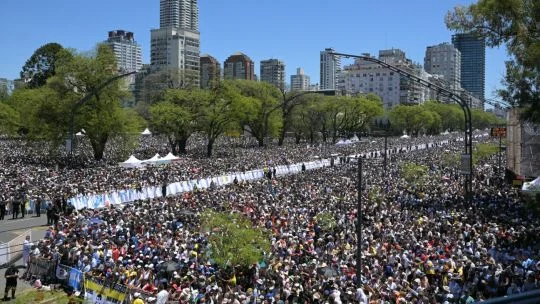
Pope Leo XIV’s visit to Buenos Aires brought together a vast public display of Catholic faith and pointed appeals about abuse, workers’ rights and disability. More than 2.5 million people attended Monday’s Mass in Palermo, the largest gathering of his pontificate so far, according to the Vatican. The scale made the service a striking show of public devotion. Its message, though, extended beyond the crowd: Leo used the day to speak about the responsibilities of families, the Church and the state toward people facing vulnerability.
The crowd filled a stretch of Avenida del Libertador more than two kilometres long. Thousands arrived before dawn to secure places near the barriers, while most followed the service on one of 33 giant screens. As Leo travelled through the area in his popemobile, worshippers chanted “Olé, olé, León, León” and waved Argentine and Vatican flags. The arrangements reveal the practical demands of a Mass on this scale: most attendees couldn’t be close to the altar, but screens and the procession gave them ways to take part.
Faith and family
At the Monumento a los Españoles, Leo, 71, described Christian faith as a source of stability amid uncertainty. The family, he said, “today more than ever represents a pillar amid the many uncertainties of our time.” He urged parents to pass on their faith through everyday gestures, framing religious practice as something carried through ordinary relationships as well as public worship. He also became emotional while speaking of his predecessor, Pope Francis, whom he called “our beloved.”
The Mass ended with communion stations where laypeople helped distribute tens of thousands of wafers. The arrangement depended on many people taking part in the service, extending the work of the clergy across a vast crowd. Marta Lima, a 63-year-old retired teacher, said the Pope’s call to strengthen family ties spoke to a wider social concern: “That is precisely what we are missing and, when it is absent, it is the beginning of all forms of violence.” Her comment gives the family theme a sharper edge: for some attendees, it was also a way to talk about social strain.
The scale of the gathering came as Leo continued an Argentine leg of his Latin American tour. He had undergone surgery for lung cancer three weeks earlier. That context added a personal dimension to a public appearance that required him to travel through the crowd and address a large outdoor congregation.
Meeting abuse survivors
Later in the day, Leo spent an hour with five people who had suffered abuse by clergy or in institutions run by the Catholic Church in Argentina. The Holy See said he met each person individually, listened to their accounts and painful experiences, and pledged to strengthen the Church’s safeguarding measures. The meeting placed survivors’ experiences alongside the day’s public celebration, underscoring the distance between the institution’s message of care and the harm people have reported within it.
A pledge to strengthen safeguards is a statement of intent, and its weight will depend on what the Church does after the meeting. The account provided by the Holy See describes the encounter but offers no detail on specific measures or their timing. That leaves the commitment open to scrutiny, particularly from survivors and others who want to see institutional promises matched by action.
Appeals on labour and disability
Leo began Monday at Pequeño Cottolengo Don Orione, a residential home for people with disabilities outside Buenos Aires. The facility houses 410 adults, most of whom receive no visits from family or friends. He said a nation’s progress should be judged in part by how it welcomes people with disabilities and special needs, adding: “Your lives are not a burden on society; they are a blessing.” The line directly challenged the idea that care for disabled people is a cost to be weighed against other priorities.
His comments arrive amid debate over the effects of President Javier Milei’s austerity policies on disability services. After negotiations involving the Church, the government and opposition, representatives agreed on a bill to guarantee funding for those services. The lower house approved it in October; it awaits a Senate vote. The dispute shows how a moral appeal can meet a practical question: whether public funding will be sufficient to support services that many people depend on.
At the Argentine Catholic University, Leo met trade unionists and social movement representatives. He called unions “an indispensable institution when they defend those who have no voice and resist the commodification of labour.” Unions have opposed Milei’s policies and called four general strikes since he took office in December 2023. Leo’s remarks placed organised labour within the Church’s account of social responsibility, while also speaking directly to a political conflict already under way.
Labour figures underline the pressure behind that discussion: unemployment reached 7.9 percent of the economically active population in the second quarter, its highest level since 2021, while informal work accounted for 45 percent of workers. Those figures describe a labour market in which many people face insecure conditions, even as unions contest the government’s direction. The numbers here are underwhelming for anyone hoping that a mass gathering alone signals broad social confidence.
What the day signals
Leo’s Buenos Aires visit joined a display of religious solidarity to encounters with people whose lives are shaped by institutional decisions: abuse survivors, disabled residents, workers and families. This is more significant than it looks. The Mass showed the Church’s ability to convene a huge public, but the day’s harder test lies in whether its appeals about protection and dignity can be reflected in how institutions behave.
If you’re working in this space, the contrast is worth watching: a crowd can make a powerful image, while safeguarding, disability support and labour conditions demand sustained attention beyond a single event. (And this is the part most people overlook.) Public attention is brief. Institutional responsibility lasts longer.
And yet. The visit offered no resolution to the debates over disability funding or labour policy, and the Vatican’s account of the survivor meeting did not specify what safeguards would change. Leo’s interventions put those issues in the same public frame as faith and family, leaving the next steps to institutions with the power to act.
Discussion
Sign in to join the discussion.