China's recent deployment of YJ-20 hypersonic missiles significantly shifts naval power in the Pacific, challenging traditional military strategies.
Strategic Shift in Naval Capabilities
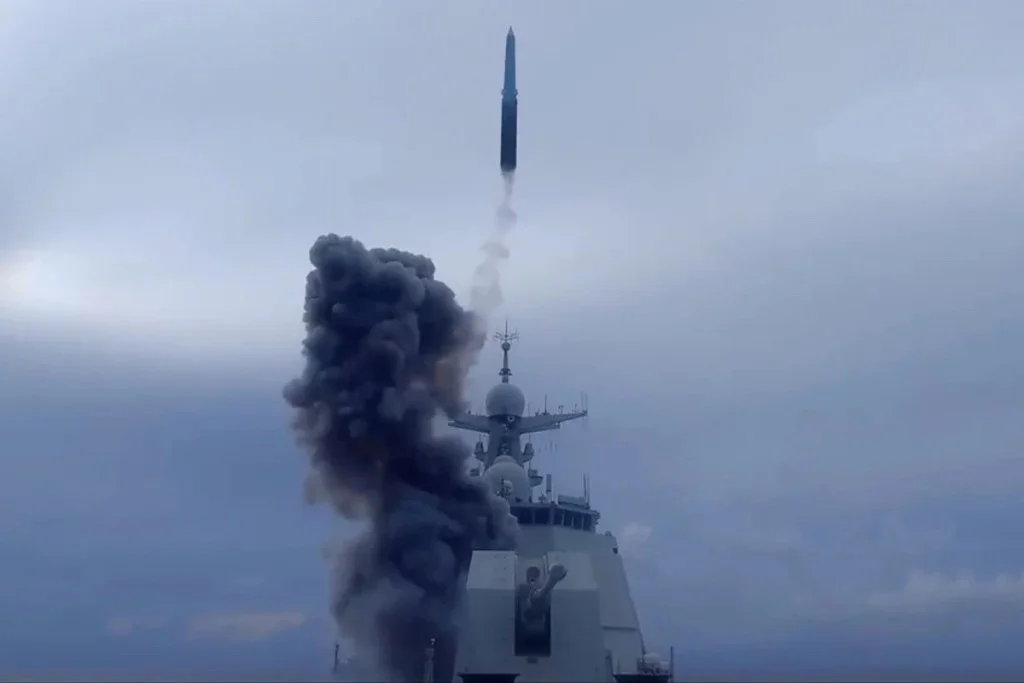
Recent presentations by Chinese state media revealed the YJ-20 hypersonic anti-ship missile being launched from the vertical launch systems of the Type 052D destroyers. This marks a pivotal moment, as the YJ-20 was previously associated mainly with China’s elite Type 055 super destroyers. Its integration into the more widespread Type 052D fleet indicates a transformative upgrade in China’s naval warfare strategy.
This shift is more than just technical; it signifies that the YJ-20 has transitioned from a high-profile prototype to a standard piece of equipment within the People’s Liberation Army Navy (PLAN). Such progress suggests that China’s hypersonic capabilities are becoming pervasive enough to change the operational conditions of the Western Pacific, putting conventional surface vessels at risk of obsolescence.
Technological Advantages of the YJ-20
The YJ-20 is a sophisticated weapon, featuring a biconic glide vehicle paired with a solid-fuel booster, achieving astounding speeds of over Mach 6 in mid-flight and descending at near Mach 10. This deviates from traditional ballistic missiles that follow predictable trajectories, which are more easily countered by air-defense systems.
Instead, the YJ-20 uses quasi-ballistic “skip-glide” maneuvers, making it more challenging for existing US Navy defense systems, like the Aegis-integrated Standard Missile-3 and Standard Missile-6, to intercept. This dynamic approach invalidates normal predictive algorithms used in missile interception, fundamentally altering attack scenarios.
New Operational Paradigms in Naval Warfare
Moreover, this integration signals a structural evolution within the PLA. Traditionally, anti-access strategies relied heavily on land-based missile systems capable of being tracked by satellite, such as the DF-21D and DF-26. Now, by embedding YJ-20s into versatile and mobile surface vessels, the PLAN has seamlessly decoupled its strike capabilities from the mainland.
Utilizing data from the Yaogan-Beidou satellite constellation, these vessels can effectively launch surprise attacks from the open ocean, extending China's reach well beyond the First Island Chain. With an effective range potentially reaching 2,000 kilometers, a Type 052D destroyer could threaten naval forces hundreds of miles away from the Chinese coast.
Changing Dynamics of Maritime Engagement
Strategic chokepoints previously considered safe havens for allied naval operations are now under the shadow of potential YJ-20 launches. This alteration means that foreign carrier strike groups no longer have the same sanctuary east of Taiwan, drastically changing the risk calculus for military engagements in the region.
Saturation and Strategic Messaging
The PLAN's rapid shipbuilding capabilities enhance the strategic implications of the YJ-20 deployment. Currently, with 10 Type 055 destroyers and over 35 Type 052D destroyers in service and more being built, the combination of these hulls allows for more than 3,800 vertical launch cells capable of deploying both hypersonic and conventional missile systems.
By equipping both classes of ships with the YJ-20, China shifts the focus from qualitative deterrence to sheer quantitative effectiveness. A Surface Action Group could initiate multiple hypersonic strikes simultaneously, quickly depleting the interceptor reserves of opposing naval forces.
The release of YJ-20 footage serves a dual purpose: it demonstrates military readiness while sending a direct message to Washington and its allies about the dangers of intervention. Domestically, this bolsters public confidence in China's military under President Xi Jinping, amidst looming potential conflicts, particularly regarding Taiwan.
Future Implications for Regional Security
The Chinese military buildup is closely aligned with intelligence estimates pointing towards a potential Taiwan conflict around 2027, coinciding with the centennial of the PLA’s founding. By that year, it is anticipated that China's hypersonic arsenal will significantly reshape the balance of military superiority in the Western Pacific.
Such advancements pose direct challenges to existing Western naval doctrines, which traditionally emphasize carrier strike groups as the backbone of power projection. The YJ-20 undermines many assumptions of Western strategies, forcing a reevaluation of operational frameworks given its rapid engagement capability.
The Escalation Dilemma
As these hypersonic missiles proliferate in naval arsenals, they complicate traditional naval doctrines and introduce a crisis of stability. The accelerated flight speeds mean naval commanders will face increasingly difficult dilemmas regarding resource allocation and response times during conflicts. Simultaneously, the indistinguishable signatures between conventional and strategic missiles could exacerbate tensions, especially if misinterpreted in a crisis context.
Regional Responses and Defense Strategies
In light of these developments, regional players are rethinking their defense structures. Japan is advancing its counter-strike capabilities by acquiring long-range missiles, while Australia is intensifying its focus on nuclear submarines and counter-hypersonic innovations through the AUKUS partnership. Concurrently, the US is investing heavily in missile defense infrastructure, particularly in Guam, to secure its pivotal military bases within the Second Island Chain.
The Path Ahead
For Taiwan, the implications of the YJ-20's introduction are profound, as it transforms the defensive landscape. The presence of these hypersonic missiles near its coast effectively eliminates its traditional protective barriers, putting critical infrastructure at significant risk.
This reality compels Taiwan to adopt an aggressive “Porcupine Strategy,” favoring cost-effective and highly mobile defense mechanisms over traditional capital assets that have become prime targets in potential conflicts. This includes enhancing its stockpile of anti-ship missiles and bolstering decentralized defensive systems.
As we look towards 2030, the widespread deployment of YJ-20 missiles signifies a marked shift in naval power, steering the Indo-Pacific toward a future dominated by advanced deterrence strategies. Establishing strategic norms and communication channels will be essential to prevent tensions from spiraling out of control, emphasizing the need for diplomacy in the face of rapidly evolving military technologies.
Ronny P Sasmita, PhD, is a senior international affairs analyst at the Indonesia Strategic and Economic Action Institution, a Jakarta-based think tank.
Discussion
Sign in to join the discussion.