Japan is advancing its hypersonic submarine capabilities, potentially enhancing its nuclear deterrence framework and maritime security strategy.
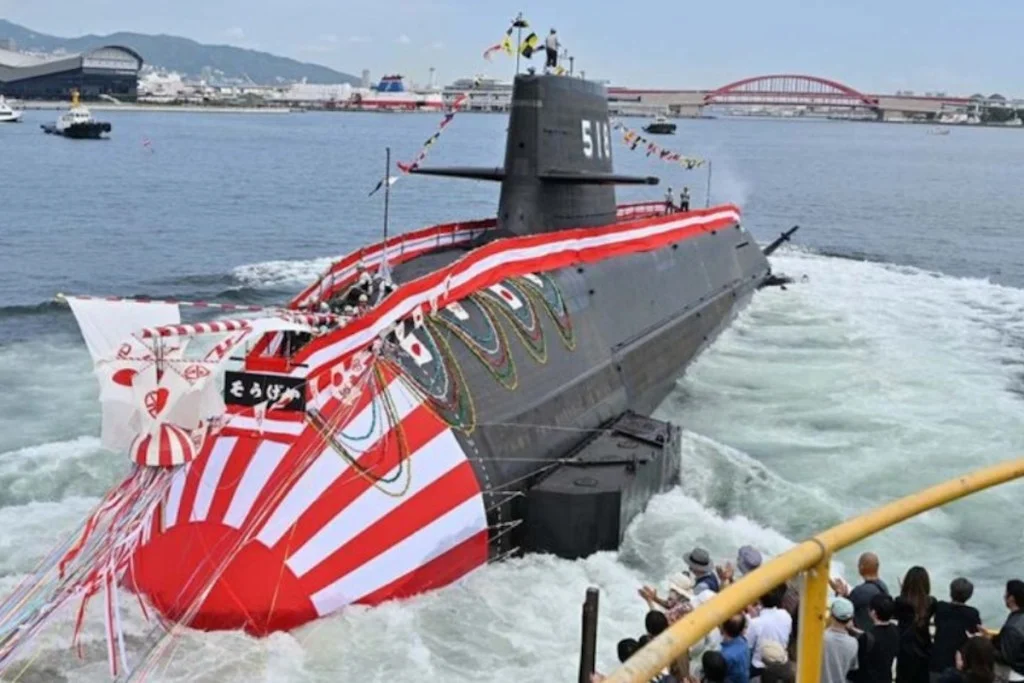
Japan's ambition to develop submarine-launched hypersonic weapons represents a pivotal shift in its military strategy, aiming for a more effective and survivable counterstrike posture. The nation's Ministry of Defense (MoD) is prioritizing this initiative in its fiscal year 2027 budget, as reported by various media outlets.
The MoD's proposal involves equipping submarines with vertical launch system (VLS) tubes capable of deploying Hyper Velocity Gliding Projectile (HVGP) missiles, which can travel at speeds exceeding Mach 5. A typical submarine design under consideration may feature two to three VLS tubes, each accommodating seven or eight HVGP missiles. This weapon system employs a robust rocket booster to ascend to the upper atmosphere before gliding towards targets, although its design poses challenges in terms of missile count and maneuverability.
Advanced variants of the HVGP, such as the Enhanced Capability Version Block 2A, are expected to achieve ranges of up to 2,000 kilometers, with plans for the Block 2B to reach approximately 3,000 kilometers. In parallel, Japan is investing in hypersonic cruise missile (HCM) technology for future underwater applications. Unlike boost-glide weapons, HCMs use scramjet engines that maintain thrust using supersonic airflow, thus offering the potential for more compact designs, despite the technological complexities involved.
Enhancing Undersea Strike Capabilities
Japan's military strategy also includes exploring launch options for modular unmanned underwater vehicles (UUVs) capable of carrying long-range strike weapons. The integration of these platforms with Japan's existing submarine fleet could present a persistent and stealthy threat capable of targeting Chinese naval forces and amphibious operations during regional conflicts.
The push for significant advances in hypersonic capabilities underscores Japan's larger strategy to build more survivable maritime strike functions. The fundamental question remains whether these submarine-launched hypersonic systems can navigate both operational challenges and political implications associated with counterstrike capabilities, while also laying the groundwork for a credible sea-based deterrent.
Navigating Strategic Waters
Survivability in maritime operations is particularly critical in strategic chokepoints, such as the Miyako Strait, which is essential for naval movements in the region. Should hostilities erupt, access through this channel could severely impact Japan's communication sea lanes and disrupt U.S. intervention efforts. Chinese naval forces potentially crossing the Miyako Strait would likely be protected by multi-layered defenses, including both aerial and naval assets.
Given the increasing sophistication of China's naval defenses, Japan's existing weapons systems may face significant challenges. For example, legacy anti-ship missiles like Japan's Type 88 may no longer effectively penetrate modern defenses, leading to a necessary shift in design towards speed and stealth in missile development, including potential implementations of newer anti-ship missiles within Japan’s HVGP project.
A submarine-launched hypersonic missile could contribute to a more resilient counterstrike capability, particularly compared to stationary assets like air bases, which are vulnerable to preemptive strikes. For instance, a recent Hudson Institute report indicated that Japan's airbases are critically lacking in hardened aircraft shelters, leaving them susceptible to attacks.
Political and Technical Challenges Ahead
While survivability is a key consideration, Japan's counterstrike strategy must also integrate intelligence, surveillance, reconnaissance (ISR) systems, effective doctrines for missile deployment, and the political resolve to act on these weapons. Currently, Japan's ISR capabilities are limited to a handful of operational satellites, which constrains its operational autonomy and may rely on U.S. support for increased situational awareness.
Additionally, Japan's operational doctrine presents a significant complexity: counterattacks on adversaries matter little if executed after an attack occurs, while acting preemptively could risk escalating tensions. This tension is compounded by domestic pacifist sentiments, which might complicate the presentation of offensive capabilities as necessary defensive measures, placing constraints on the operational capabilities of Japan's military.
Potential advancements could mirror South Korea's developments, which include conventional submarine-launched ballistic missiles that, while not nuclear, highlight a trend toward enhancing strike capabilities. The significance for Japan lies in establishing a survivable submarine platform with long-range strike options that could one day support a nuclear deterrent strategy.
Recent statements from Japanese leadership hint at an evolving nuclear narrative, with discussions around nuclear capabilities becoming more pronounced, reflecting a potential openness to reconsider Japan's stance. With substantial fissile material stockpiles and an advanced nuclear infrastructure already in place, developing VLS-equipped submarines could close the strategic gaps necessary for a future-oriented nuclear posture without explicitly committing to nuclear armament.
If Japan successfully integrates resilient undersea capabilities with independent ISR, solid military doctrine, and sufficient political will, it could enhance its regional deterrence capacity. Furthermore, this approach might lower the barriers to adopting a maritime nuclear option should its strategic priorities shift.
Discussion
Sign in to join the discussion.