A calmer public style has helped Flávio Bolsonaro broaden his appeal, but his campaign still rests on his father’s legacy and a contested record.
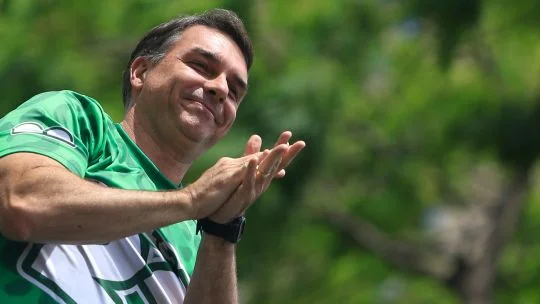
Flávio Bolsonaro’s appeal in Brazil’s presidential runoff rests on a balancing act: he presents himself as more approachable than his father, Jair Bolsonaro, while making clear that he intends to carry the family’s political legacy forward. After the first round, that mix put him ahead of President Luiz Inácio Lula da Silva and made him a narrow favourite for Sunday’s vote.
At a rally in São Paulo attended by more than 70,000 people, Flávio promised supporters they would see his father place the presidential sash on him. Jair Bolsonaro, who is serving a 27-year sentence under house arrest after a failed coup attempt following his 2022 election defeat, has remained a vivid presence in the campaign. His image appears on rally T-shirts and posters; supporters chanted, “Come back Bolsonaro!”
Flávio has said his father was pleased with the first-round result and “very happy to have been heard by the majority of the Brazilian people.” He has also pledged to free him. Yet the senator said in an interview that giving his father a role in a future government was “not on the radar.”
That distinction may carry limited weight with voters who see the two men as politically inseparable. “He continues to act as an avatar for his father. I have no doubt who will have the final say should Flávio Bolsonaro be elected,” political analyst Thomas Traumann told AFP.

A family name and a distinct style
Flávio, 45, is Jair Bolsonaro’s eldest son and a law graduate from Rio de Janeiro state. He entered the state legislature at 21 and won a seat in the Senate at 37. His public manner is softer than his father’s: a jovial smile, fewer rough edges and a relaxed Carioca style that has helped him court voters beyond the family’s conservative base, including people frustrated with Lula’s left-wing government.
On the trail, he has danced to funk music alongside young right-wing influencers. In their only debate so far, Lula called him a “Carioca hustler.” Flávio has described himself as a devoted family man; he and his wife, Fernanda, a dentist, have two daughters. “God is using me to save Brazil,” he has said.
The family’s political footprint extends well beyond the candidate. Jair Bolsonaro’s son Carlos and his wife Michelle have both served in the Senate. His youngest son, Jair Renan, and his brother have won seats in the lower house of Congress. The size of that network helps explain why Flávio’s campaign is also a referendum on the wider Bolsonaro brand.
“I may be calmer, more prone to smiling, more relaxed and moderate. But I have the blood of a Bolsonaro in my veins,” Flávio told supporters.

Policy promises and unresolved questions
His campaign has focused on attacks against Lula, tougher crime policy, expanding prison capacity by 500,000 places and reducing government spending. Critics have pressed him to explain how he would cut spending while preserving his pledge not to reduce social benefits.
Flávio has also promised closer relations with the United States. His rallies have featured large US flags and inflatable figures of his ally Donald Trump. But his positions can be difficult to pin down. After sharply criticising Lula’s proposal to shorten Brazil’s workweek, Flávio ultimately voted for it. He has also made more effort than his father to address women’s issues.
His record and past statements offer a clearer view of some of his ideological commitments. In a 2017 book, he presents himself as firmly anti-left and defends many of Jair Bolsonaro’s ideas. He calls Brazil’s 1964 military coup a necessary intervention to stop a communist takeover, and characterises the period of military rule, which ended in 1985, as “a period some like to call a dictatorship.” He praised Colonel Carlos Alberto Brilhante Ustra, a convicted torturer, as a “national hero” and an “upright, principled man” who helped preserve democracy. He has also opposed LGBT-inclusive education policies, describing them as an attack on children and families, and defended gun ownership.
Flávio’s campaign has faced scrutiny, too. During the race, reports emerged that he was under investigation over alleged corruption and money laundering tied to the financing of Dark Horse, a biopic about his father. While serving in Rio’s state legislature, he was accused of taking a share of aides’ salaries in a kickback scheme; that case was dismissed. He has also faced questions about alleged links to militia figures in Rio de Janeiro and denies wrongdoing.
The runoff will test whether Flávio can convert his more measured image into a coalition broad enough to win, while retaining the voters drawn to his father’s confrontational politics. His campaign has made the family connection its clearest asset—and left voters to decide how much independence that connection allows.

Discussion
Sign in to join the discussion.