North Korea's recent submarine missile tests highlight its pursuit of a sea-based nuclear deterrent, despite facing significant engineering hurdles.
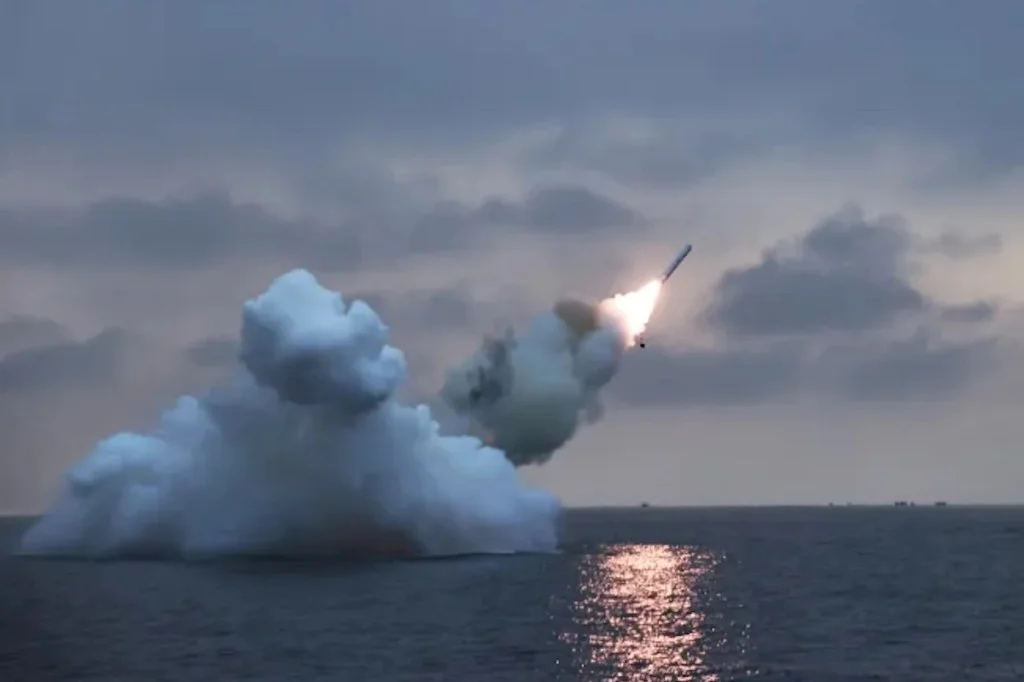
North Korea's latest underwater launch of strategic cruise missiles illustrates a significant push toward establishing a viable, sea-based nuclear deterrent. This comes even as the nation grapples with notable technological and operational challenges that could hinder its maritime ambitions.
The recent test, which marked North Korea's first public underwater cruise missile launch in nearly three years, involved firing two types of submarine-launched strategic cruise missiles into the Sea of Japan. Reporting from state media and various military sources confirms that the exercise was overseen by key defense officials Kim Jong Sik and Jang Chang Ha, aiming to validate the operational readiness of the nation’s naval systems and reinforce the credibility of its nuclear deterrent.
Pictures from the launch reveal that the missiles were deployed from the Hero Kim Kun Ok, a modified diesel-powered submarine introduced just last month. South Korea's Joint Chiefs of Staff monitored the projectiles' trajectory and noted that one missile was launched from a vertical system, while the other came from a torpedo tube. This methodical approach potentially complicates enemy air defense systems, presenting a diversified threat.
Despite the impressive nature of this test, it's premature to assume that North Korea has achieved a fully operational sea-based nuclear capability. Successfully launching a cruise missile from a submerged submarine is a significant milestone, yet it is merely one aspect of a more complex system needed for a credible deterrent.
Operational Limitations and Future Goals
For a submarine to be deemed effective, it must demonstrate reliability, maintain its payload, elude detection, and function under realistic conditions. Much emphasis is also needed on developing a command-and-control framework that ensures communication with submerged assets.
North Korea's broader strategy has not been limited to its submarine fleet. The country has previously showcased its ability to launch strategic cruise missiles from surface vessels, highlighting a dispersed approach to its maritime capabilities. Notably, during a military review in April 2026, Kim Jong Un oversaw a launch from the Choe Hyon, North Korea's largest destroyer, which was coupled with test-firings of other missiles. This indicates a calculated distribution of missile platforms, which aims to confuse or overwhelm allied detection capabilities.
Currently, while testing of surface platforms is ongoing, there exists a looming vulnerability as surface ships are generally more exposed to enemy action. Thus, there’s an evident urgency for North Korea to enhance its undersea capabilities, which it seems to be addressing through its recent submarine developments.
Future of Submarine-Launched Ballistic Missiles
As the North Korean leadership prepares for potential advancements, rumors of upcoming tests involving submarine-launched ballistic missiles (SLBMs) are emerging. The U.S. Congressional Research Service reported that North Korea has previously flight-tested the Pukguksong-3 and has shown prototypes for additional versions, pointing to an expanding arsenal.
However, the challenge remains in developing submarines that can effectively deploy these missiles. Research indicates that North Korea is pursuing a dual-track strategy involving retrofits of older submarines for immediate capabilities, while also setting sights on more advanced long-term projects.
For instance, the Hero Kim Kun Ok represents a heavily altered Romeo-class submarine designed to accommodate SLBMs through innovative modifications, albeit at the cost of structural integrity due to engineering compromises. Numerous reports highlight how these alterations could affect the submarine's operational capabilities, particularly under the pressures of underwater operations.
Constraints and Assistance in Development
Structural issues, such as a compromised hull from the modified dimensions, create challenges for both stability and stealth under water. Changes affecting submerged maneuverability and additional noise factors, which can make these submarines easier to detect, have been critically examined in recent analyses.
North Korean aspirations for a more advanced fleet may also involve outside assistance, possibly from Russia. There are theories suggesting that North Korea's development of a nuclear-powered submarine could be influenced by Russian technology, as both nations see strategic value in a nuclear-capable North Korea.
Recent imagery of a purported new submarine indicates that the country may be progressing towards a larger strategic vessel, although comprehensive operational capabilities like a compact nuclear reactor remain years away. Until then, North Korean subs will likely maintain a precarious balance between developing tactical capabilities and addressing substantial engineering setbacks.
The Current Military Landscape
Even with modifications, submarines like the Hero Kim Kun Ok can still pose a genuine threat, particularly through unpredictable missile launches that test the limits of opposing anti-submarine warfare systems. Despite the noise and vulnerability concerns, the capacity to launch missiles from a concealed position continues to challenge regional security dynamics, particularly for South Korea and allied forces.
In summary, while North Korea's recent submarine missile tests demonstrate its committed efforts toward enhancing its naval deterrent capabilities, true effectiveness hinges on overcoming existing design and operational limitations. Ongoing developments, potentially supported by foreign technology, will be critical to realizing a sustainable undersea nuclear strike force.
The coming years will reveal whether North Korea can resolve these challenges and fully capitalize on its ambitions for a credible sea-based nuclear deterrent.
Discussion
Sign in to join the discussion.