Celebrating Milena Plebs: The Balance of Tradition and Innovation in Tango
Published Sep 05, 2026Reads 649By Michelle Edgar
Milena Plebs embodies the fusion of tradition and contemporary expression in tango, fostering its evolution while honoring its rich history.
The Dance of Tradition and Innovation in Tango
Milena Plebs stands as a transformative figure in tango, a dance form rich with history and cultural significance. Celebrated recently at the Tango BA Festival and World Championship for her illustrious forty-year career, Plebs doesn't just reflect on the past; she actively charts a future for tango. "For me, it is also important as a seed for the future, not just to acknowledge past milestones,” she asserts, a sentiment that encapsulates her approach. It's evident from her career that she doesn't view tradition as something to be locked away—rather, she sees it as a foundation upon which to innovate.
The recognition she received wasn't merely a personal accolade; it highlighted her multifaceted relationship with tango. “For me, it means bringing visibility to the different stages and, above all, the various activities within tango that I engage in: dancing, choreographing, directing, producing, teaching and researching,” she explains. This perspective is crucial; it indicates that her journey is as much about the evolution of tango as it is about her individual milestones.
Throughout her career, Plebs has deftly navigated the delicate balance between preservation and reinvention. She entered the tango scene already equipped with six years of stage experience and a solid grounding in contemporary dance, soaking in traditional expertise while simultaneously questioning the limitations of convention. Her extensive collaboration with Miguel Ángel Zotto, dubbed a driving force behind tango, allowed her to explore this complex relationship deeply. Together, they bridged Argentine tango from the local milongas to international acclaim with productions like *Tango Argentino*, reigniting global interest in the dance.
But Plebs maintains that true appreciation of tango goes beyond mere replication. Her training in classical dance introduced a contrasting vocabulary—one that invites dialogue rather than dictates conformity. This ongoing conversation between traditional foundations and contemporary interpretation informs not only her philosophy but also her works, such as *Tramatango*, which fuses these two worlds.
As Plebs puts it, the common thread throughout her career is to understand tradition while injecting fresh perspectives into the dance. This emphasis remains significant today; her constant return to the roots of tango—those solid, minimalist movements—is a reminder that complexity often stems from simplicity. “I feel that is the origin of all dance – a simple dance, a tango de salón,” she articulates. For her, every moment on the dance floor serves as an opportunity for exploration and improvisation, both of which she sees as vital to the evolution of tango.
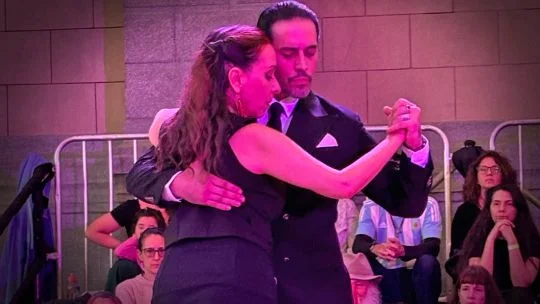
Honing in on her recent celebration, Plebs chose to dance with two partners who each embody different aspects of her artistic journey. Javier Rodríguez, a dancer she has long admired, reflects a deep personal connection while Juan Malizia, a newer acquaintance, presents a fresh challenge. By dancing with Malizia, Plebs summarizes her philosophy as embracing the future rather than dwelling only on the past. She encapsulates her selection process simply: “Honestly, I chose them because I wanted to have fun!”
The takeaway here is profound. Tango can indeed honor its roots without becoming stagnant. Plebs is passionate about instilling this philosophy in younger generations of dancers. She encourages them not to limit themselves to one teacher or style but to study broadly before forging their unique expression. “Take classes with various teachers, and then create your own recipe with the different knowledge you have acquired,” she advises.
Ultimately, while technical mastery is foundational, it should serve as a launching pad to greater artistic freedom. Improvisation, for Plebs, opens doors to myriad possibilities within each tango sequence. This emphasis on curiosity and exploration underscores plebs' approach: preserving the essence of tango while continually enriching it with personal expression.
As she eloquently articulates, the heart of tango lies not just in performance but in the embrace, a symbolic exchange of energy and connection that demands respect. In Plebs' perspective, the evolution of tango must keep this core value intact, ensuring that the beauty of the dance can continue to thrive in shared social spaces. The respect for one's partner and the surrounding dancers creates an unbreakable bond that transcends generations—one that is artistically invaluable as tango evolves alongside its dancers.
Redefining Tradition in Tango
Milena Plebs isn’t just a steward of tango; she’s a sage, urging dancers to embrace the roots of this art form while pushing its boundaries. Her view is grounded in the belief that understanding tango's foundational elements is paramount for genuine expression. “The essence of tango is found in the connection between partners—the depth of their embrace and the mutual understanding of their roles,” she states emphatically. This connection, far from being a relic, is vital to ensuring that tango remains relevant in an ever-changing world.
What’s compelling here is the dynamic relationship between Buenos Aires—the heart of tango—and its global audience. Plebs notes that the city's influence is a two-way street. As dancers and teachers from around the world immerse themselves in tango, they absorb its nuances and contribute their interpretations and innovations. This cycle of exchange enriches the dance, making the tradition an evolving tapestry rather than a rigid template. Ultimately, Plebs suggests that every journey back to Buenos Aires transforms not just the dancer but the dance itself, symbolizing a blend of tradition and new ideas.
The Importance of Historical Context
Plebs' call to action for younger generations is clear: Before attempting to innovate within the tango, establish a strong grasp of what came before. “It’s essential to return to the fundamentals—understand the traditional steps, the history, and the cultural backdrop that shaped them,” she advises. This understanding serves as a foundation, allowing dancers to infuse their unique perspectives into the art.
She also emphasizes the rigors of creation. Each dance or performance should come with a profound sense of purpose. A creator should ask themselves why the piece matters and what knowledge is needed to convey that message effectively. This standard of scrutiny is not just mere formality; it promotes thoughtful artistry where tradition and experimentation exist in harmony. In Plebs’ eyes, mastering the techniques of tango and honoring its history isn't confinement—it's liberation.
Beyond Dance: The Broader Implications of Tango
After 40 years of deeply engaging with tango, Plebs expresses an evolved interest—seeing it as a vital part of human existence itself. The connection forged through dance doesn’t only shape the physical body; it nurtures mental health and fosters relationships. “Tango allows for a dialogue between partners, intertwining their movements and emotions; it fuels community building and creates connections that transcend borders,” she reflects.
In essence, the power of tango lies in its ability to bring people together and facilitate interactions that might never happen otherwise. Plebs sees this as integral to the art’s purpose: not merely to entertain but to enrich lives. After decades of this journey, her ongoing passion for tango demonstrates a profound respect for its roots while daring to chart unknown paths—a balance all artists should aspire to. The most genuine homage to tango's rich history is to harness that knowledge and courageously navigate forward, exploring uncharted territories of expression.
Discussion
Sign in to join the discussion.