Fishers in southern Cameroon report restricted access, oily nets and declining catches as experts warn of wider risks to coastal ecosystems.
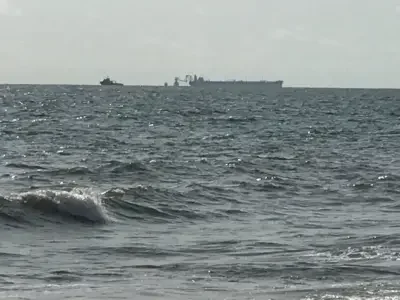
Offshore oil and gas operations off southern Cameroon bring a visible industrial presence to the coast—and a growing set of questions about fishing access, pollution and marine life. Residents and local experts describe declining catches, oily fishing nets and stranded marine mammals. They also point to gaps in the evidence: reports of oil residues have not been independently analyzed, and inspection results are not public.
For Dede Sluk, a 35-year-old father of three in Grand-Batanga 2, the issue is immediate. Fishing grounds near the offshore platforms are off limits because the Battaillon D’intervention Rapid (BIR), the special army unit guarding the petroleum installations, bars passage. “We don’t have access to areas with high fish stock,” he says. His household’s income and ability to provide for his children depend on a fishery that he says is harder to reach and less productive.
Oil and gas contributed FCFA 774.51 billion to Cameroon’s budget, according to the Extractive Industries Transparency Initiative’s (EITI) 2023 report. But the financial contribution sits alongside costs that coastal residents say they bear directly. The debate around offshore development in Kribi is therefore about more than production: it touches access to food, local livelihoods and the health of marine habitats.
Restricted fishing grounds, rising prices
Several oil and gas installations operate off the Kribi coast. The Ebome Marine Terminal, operated by Perenco and SNH west of Grand Batanga, is about 6.5 kilometers from the Kribi shoreline. Its flames and smoke are visible from the coast. The Sanaga 2 facility is connected by undersea pipelines to onshore infrastructure at Bipaga, while the Kome-Kribi 1 floating storage and offloading terminal, built in 2003, is west of Kribi Port. The Sanaga 2 site and Kome-Kribi 1 are among the named facilities in the area. The Hilli Episeyo, operated by Golar LNG, Perenco and the National Hydrocarbons Corporation (SNH), left Cameroon in July 2026 after eight years.
For fishers, the facilities’ location and security boundaries can mean longer trips to find a catch. Divine Francois Xavier Mbunje, a fisherman, geologist and head of a 150-member fishermen’s union at Grand Batanga beach, says platforms occupy rocky marine areas where fish breed. He estimates that fishing close to shore yields little, while a trip three kilometers out can produce around 40 kilograms.
Laure Ndingue, a 50-year-old mother of five who has roasted fish on Grand Batanga beach for more than a decade, has watched prices rise as supplies have fallen. “Growing up, six barfish were sold for FCFA 500 (USD 0.85); the price jumped to FCFA 1,000 (USD 1.70) and now is FCFA 5000 (USD 8.54) per kilogram,” she says. “Before, we were not suffering; fish stocks have declined.” Even frozen fish, she adds, has become expensive.
Mbunje argues that clearer demarcation of platform zones and fishing areas could help communities plan their work. Sluk wants support that would let fishers travel farther: fish farming, loans to offset lost catches, subsidized engines and better gear. He estimates nylon fishing equipment costs FCFA 1 million (USD 1,720), with an engine adding FCFA 1.5 million (USD 2,572). “Motorised gear will help us fish towards Ntem, Lokonje, and Douala away from the offshore platforms,” he says. “We now rely on crabs to feed the family, with fish becoming rare.”
Oily nets and unverified reports
In early 2026, fishers in Ebodje reported a substance on their nets that smelled like crude oil. The village is about 50 kilometers from Kribi and lies within a marine protected area. Ebodje fisherman Emile says the phenomenon persisted for more than three weeks before fading. Leon Kisito Bekwale, who has fished for about 35 years, still has nets stained dark with oil.
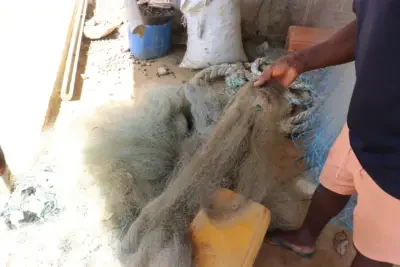
Leon Kisito holding oily nets in Ebodje, Cameroon. Photo by Leocadia Bongben. Used with permission.
Bekwale is unsure where the residue came from. Local wooden boats travel only about three kilometers, he says, and the substance appeared inside the protected area, far from the platforms. Fishers reported the incident to the park conservator and nongovernmental organizations.
A Perenco spokesperson told Global Voices by email that the company was unaware of any incidents at its northern or southern sites. The spokesperson suggested the report might concern oil slicks that have drifted from Nigeria toward Cameroon’s northern coast in recent years, possibly from tanker waste or activity in Nigerian oil fields, and said this would not be linked to Perenco. The company also said Cameroonian security forces patrol its sites and had reported no incidents.
Jean Kenfack, the seas and oceans focal point at the Ministry of Environment, Nature Protection and Sustainable Development (MINEPDED), also questioned the report. He said a departmental delegate would transmit incident information to the ministry. If a spill is confirmed, he said, an inspection team is sent to identify its source, and a pumping station in Kribi is managed by the ministry with SNH and the Marines.
Marine biologist Joel Wanba, a megafauna officer at Tube Awu in Ebodje, connects the residue to coastal activity but says his organization cannot test it. Its budget is too small to analyze the substance, he says, leaving the source unresolved. That uncertainty matters: without testing, residents’ observations can identify a problem but cannot establish which activity caused it.
Tar balls, wildlife and habitat damage
Wanba says tar balls—lumps formed when crude oil enters seawater—are frequently found along the coast and in the Manyange Na Elombo Campo marine protected area. Sea turtles may mistake them for food, with potentially fatal consequences. He also warns that contaminants can accumulate in fish and other marine organisms, then enter human diets. Oil residues can block sunlight and damage living tissue, while spills may harm seagrass beds and coral reefs.
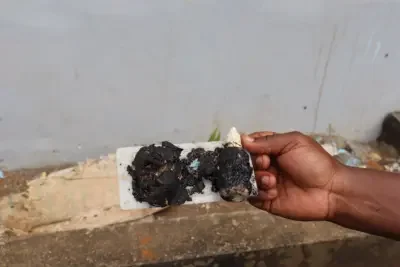
Tar-Balls-in-Ebodje-Kribi-Cameroon by Leocadia Bongben. Used with permission.
Tube Awu surveyed eight sites using bioindicators: plants, animals and microbes whose presence or absence can indicate environmental conditions. Wanba says some indicators were missing from several sites, a finding he associates with an unhealthy environment and dying corals. The survey offers a warning signal, though it does not by itself identify a particular source of damage.
Cedric Fogwan, a marine biologist with the African Marine Mammal Organization (AMCO), says offshore work can affect whales, dolphins, turtles and sharks by disrupting feeding and breeding areas. Noise is another concern. Whales and dolphins in shallow water use echolocation to communicate and navigate; industrial noise can interfere with that behavior, Fogwan says, potentially disorienting animals and contributing to strandings or entanglement in nets.
Pipelines and platform structures can also disturb coral habitats and reduce the diversity of life on the seafloor. Fogwan says ecosystems may recover when a platform remains in place only briefly, but the extent and pace of recovery depend on the disturbance. He points to tourism in Seychelles and Zanzibar as examples of economies built around conserving natural resources, and questions a development model centered on ports and oil extraction.
Oversight and the evidence gap
MINEPDED oversees environmental protection related to offshore exploitation. Cameroon’s Petroleum Code and the Abidjan Convention set out measures to combat marine pollution in West and Central Africa. SNH oversees the National Oil Spillage Contingency Plan. Cameroon’s National Environmental Management Plan, adopted in 1996, includes pollution controls, risk mitigation and environmental impact assessments before development begins.
Whether those provisions are applied consistently is difficult to assess. Researcher J. Folack of IRAD RHSM cites budget limits, a shortage of research aimed at specific targets and overlapping responsibilities among ministries involved in coastal management as obstacles to implementing the plan.
MINEPDED conducts annual inspections to check whether environmental impact studies are updated and reviews environmental management plans for offshore facilities twice a year. The results, however, are not public. That leaves communities with limited access to information about risks, inspection findings and the follow-up to reported pollution.
Sluk’s request is practical: mark the fishing areas, improve access to equipment and give local fishers a way to reach productive grounds. “With demarcation and good fishing gear, we can get enough to feed our families, and sell some to change our standard of living,” he says. For Cameroon’s coastal communities, the value of offshore development will be measured partly by whether those working at sea can continue to make a living—and whether reports of environmental harm can be checked with timely, public evidence.
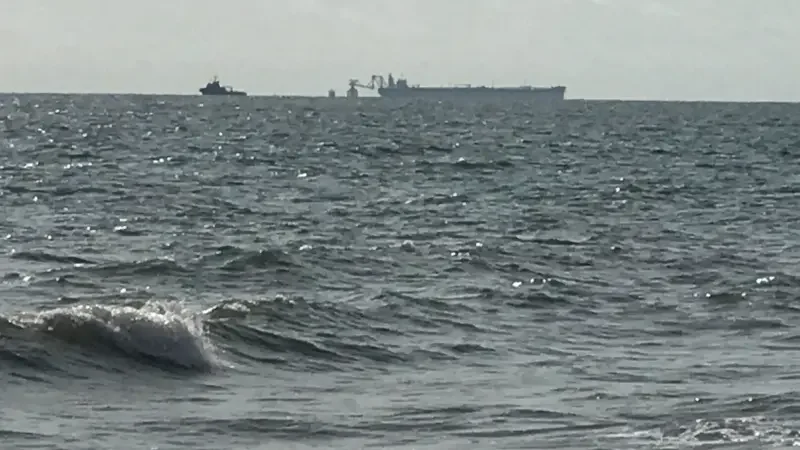
Offshore platform from Garand-Batanga Beach, Kribi South region of Cameroon. Photo by Leocadia Bongben. Used with permission.
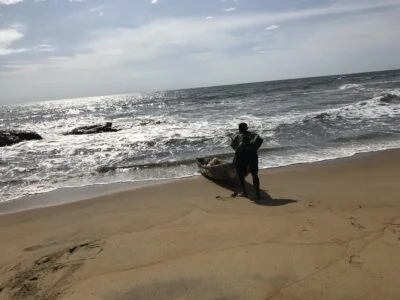
Fisherman with a wooden boat at Ebodje Beach in Cameroon. Photo by Leocadia Bongben. Used with permission.
Discussion
Sign in to join the discussion.