Estudiantes held Flamengo scoreless with 10 men, then beat the holders 3-2 on penalties to book a final against Palmeiras.
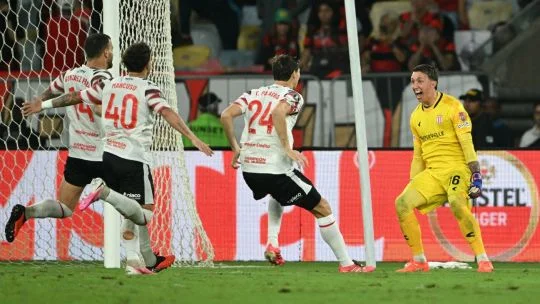
A shootout decides a bruising semi-final
Fernando Muslera’s three penalty saves sent Estudiantes past defending champions Flamengo and into the Copa Libertadores final, after a tense, scoreless second leg at Rio de Janeiro’s Maracanã on Thursday. The Argentine club won the shootout 3-2, turning a match shaped by Flamengo’s pressure and Estudiantes’ resistance into a contest of nerve from the spot.
Muslera, the 40-year-old Uruguay international, stopped efforts from Jorginho, Lucas Paquetá and Bruno Henrique. Three saves in one shootout is a decisive contribution by any measure. Yet the sequence also depended on the rest of the team: Estudiantes had to keep the tie level long enough for penalties to matter, then score enough of its own attempts to claim the result.
A scoreless match can hide a great deal of work. The scoreboard records no goals, but the teams still have to manage space, withstand pressure and avoid the mistake that ends a tie. Here, Estudiantes did that while a player down for much of the second half. The eventual shootout win makes the result look clean; the route to it wasn't.
Ten men hold firm
Estudiantes lost Baltasar Rodríguez to a second yellow card in the 50th minute. From then on, the visitors had to defend with 10 players against a Flamengo side seeking the goal that could settle the semi-final. They absorbed the pressure and kept the Brazilian club from scoring, leaving the tie goalless across both legs and forcing the penalty decider.
Playing with fewer players changes more than the shape of a formation. It can leave teammates covering greater distances, make it harder to keep possession and demand quick decisions about when to press and when to retreat. A team in that position often has to accept that it won't control the match in the usual sense. The immediate task becomes limiting danger, staying organized and preserving a chance to advance.
That task carries a physical cost, too. Defenders may need to shift across the field more often, while midfielders face a difficult choice between supporting the attack and protecting the space in front of the back line. Estudiantes still had to hold its discipline for the remainder of the match. One lapse could have undone all the work that came before it.
Flamengo couldn't turn its pressure into a goal. That's the central fact of the second leg, and it helps explain why the tie reached penalties. Estudiantes' defensive effort wasn't merely a prelude to Muslera's heroics; it created the conditions for the goalkeeper to decide the contest.
Why the goalkeeper's role changes at the spot
Penalty shootouts strip a complicated team sport down to a sequence of individual attempts. The kicker chooses where and how to shoot; the goalkeeper tries to read that choice and react in time. But the outcome doesn't rest on reflexes alone. Positioning, patience and the ability to stay composed while the other side holds the initiative all matter, especially when each attempt can shift the pressure.
Muslera's three stops gave Estudiantes a clear edge in that exchange. He denied three Flamengo players, but the shootout was still a team result: Estudiantes won 3-2, which means its own successful kicks mattered as much as the saves. A goalkeeper can create the opening, but teammates have to convert it into advancement.
And this is the part most people overlook: a shootout doesn't erase what happened during the match. It rewards a team that has kept itself in contention, and it magnifies the consequences of a small number of moments. For Estudiantes, those moments came after a long spell of defending with 10 men. The penalties supplied the finish; the second-half resistance made that finish possible.
Pressure is not evenly distributed during a shootout. A saved attempt can change how the next kicker approaches the ball, while a scored penalty can restore some calm. That pattern doesn't guarantee a particular result, and it shouldn't obscure the skill involved. It does help explain why a goalkeeper's saves can become the defining image of a tie that was also decided by collective effort.
A final with a wider historical stake
Estudiantes will meet Palmeiras in the final on November 28 at Montevideo’s Estadio Centenario. The Argentine club will chase its fifth Libertadores title and its first since 2009. Those details give the final two distinct stakes: the chance to add another championship to the club's record, and the chance to end a wait that has lasted since its previous title.
The final also puts a broader run on the line. Brazilian teams have won the competition every year since 2019, seven consecutive titles according to the source. Estudiantes' progression means a club from outside Brazil will contest the next final, but that alone doesn't end the streak. The title still has to be won on the field.
That distinction matters. A run of titles can suggest sustained strength, but a final is one match between two teams, with its own tactical demands and turning points. Palmeiras will enter as Estudiantes' opponent, not as a stand-in for every Brazilian club that won before it. The history adds context; it doesn't settle the outcome.
What the result says about Estudiantes
This is more significant than it looks. Estudiantes didn't reach the final through a comfortable second leg or a late goal. It survived a scoreless match away from home, lost a player early in the second half and then won a shootout against the defending champions. That sequence points to a team able to remain in a tie when the match stops going to plan.
If you're working in this space, the useful detail is how the result was built: a defense that held under pressure, a goalkeeper who made the decisive interventions and teammates who completed enough of their own attempts. Those elements are connected. A shootout win makes the goalkeeper the headline, but the team's earlier discipline kept the headline possible.
There are limits to what one semi-final can establish. It doesn't show how Estudiantes will handle Palmeiras, or whether the same approach will work in the final. It does show that the club can endure a difficult match without needing to dominate it. That's a practical quality in knockout football, where advancement can depend on preserving options until the final whistle.
For now, the path is straightforward: Estudiantes have earned a place in the final, and Muslera's saves will be remembered as the turning point. The harder question comes next. Can the club carry the defensive resolve it showed at the Maracanã into a match that would deliver its first Libertadores title since 2009? A chance to answer it awaits in Montevideo.
Defiance, then the spot kicks. And a final still to play.
Discussion
Sign in to join the discussion.