An F-22 pilot has directed a YFQ-44A in flight, advancing the Air Force’s drone wingman program as questions remain about autonomy, cost and Pacific operations.
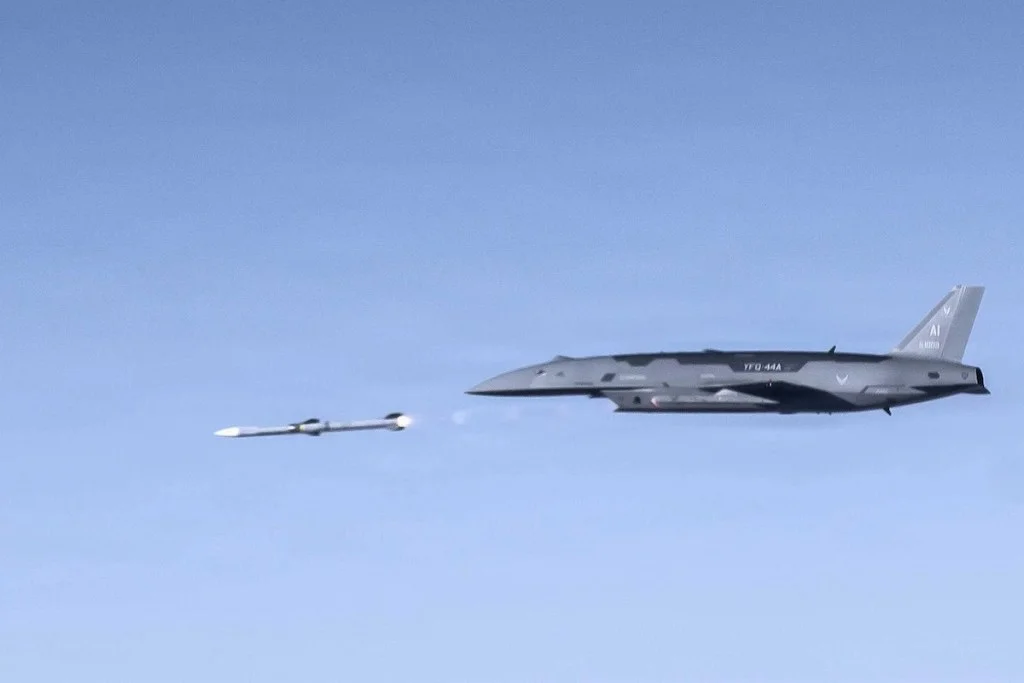
The US Air Force has demonstrated a key part of its drone wingman concept: an F-22 pilot can send mission updates and tactical directions to an uncrewed aircraft from the cockpit. The test moves the Collaborative Combat Aircraft program closer to operational trials, while exposing the gap between a successful control demonstration and the harder demands of combat.
A pilot directs the drone in flight
This month, an F-22 Raptor and an uncrewed YFQ-44A Fury launched from Edwards Air Force Base and joined up in the air. The Raptor pilot then transmitted revised mission plans and high-level tactical instructions through a data link. Anduril and the Air Force said the drone’s autonomy software converted those directions into flight maneuvers and simulated combat tasks in real time. The test was first reported by The War Zone.
The pilot’s role was closer to an airborne mission coordinator than a joystick operator. That distinction matters: the Air Force wants crewed aircraft to direct autonomous teammates while allowing the drones to handle some of the immediate flight and task execution. The test was coordinated with the 412th Test Wing and the Experimental Operations Unit, based at Nellis.
It marks progress in the service’s Collaborative Combat Aircraft program, which initially assigns F-22s the job of coordinating semi-autonomous wingmen. The next major step described in the program is large-force integration testing at Exercise Emerald Flag in December. The Air Force aims to field at least 500 Increment 1 CCAs by 2032, pairing them with crewed fighters to increase the number of aircraft available for missions and reduce the workload on individual pilots through new digital cockpit systems.
The force structure problem behind the program
The CCA effort is a response to a shrinking US fighter inventory and the difficulty of operating in the Western Pacific. A September 2026 Congressional Research Service report puts the Air Force’s combat-coded fighter fleet at 1,098 aircraft in 2026, below the 1,145-jet minimum set by Congress. The service wants 1,558 crewed fighters by 2035, but rebuilding the fleet faces long-running procurement delays and constraints on production.
The CRS report attributes the shortage to decades of post-Cold War reductions, slow procurement and an aging fleet averaging 27.4 years. Falling aircraft availability, parts shortages, bottlenecks in the defense industrial base and a deficit of 1,900 pilots add to the strain. CCAs offer a possible way to add aircraft to the force without buying every additional capability in a crewed fighter.
That additional mass is intended to help counter China’s layered air defenses. In a February 2025 Pacific Forum report, Olli Suorsa describes a network in the South China Sea that brings together ground, naval and airborne interceptors with integrated sensors. It includes Russian S-300 and S-400 systems and China’s HQ-9 missiles, which can reach hundreds of kilometers out to sea.
Suorsa also points to naval combatants carrying a combined 1,900 vertical launch cells, as well as J-16 and stealth J-20 fighters armed with long-range PL-15 missiles. KJ-500 radar aircraft can provide targeting information. Against this kind of network, adding more crewed fighters alone may not offer the numbers or flexibility planners want.
The promise: more sensors and weapons in the air
A February 2024 Mitchell Institute report by Mark Gunzinger and co-authors sets out the operational case for CCAs. Depending on the mission, the aircraft could carry radar, infrared sensors, electronic warfare jammers, decoys or air-to-air missiles. The idea is to field these capabilities at a lower cost than buying additional crewed fighters.
In this approach, CCAs would fly ahead of aircraft such as the F-22, gathering sensor data and helping create tracks suitable for interception. Secure data links could pass those tracks to pilots farther back, who would coordinate strikes from standoff range. The drones could also jam enemy radars, draw fire and keep pressure on opposing aircraft between crewed strike missions. The intended effect is a wider screen of sensors and shooters, with the F-22 retaining more distance and preserving its low-observable characteristics.
The same concept depends on accepting that some uncrewed aircraft could be lost. Gunzinger and his co-authors describe CCAs as attritable forces: aircraft that can absorb risks and losses that would be harder to accept for a crewed fighter. Their potential value rests on the combination of adaptable payloads, larger numbers and the ability to operate from sites beyond major air bases.
Costs, detection and autonomy remain obstacles
That operational promise has not been established in a real conflict. In an August 2026 interview, Hudson Institute senior fellow Bryan Clark said wargames with senior US Navy leaders at the Naval War College exposed problems with manned-unmanned teaming. He warned that drones could be easier to detect than stealth fighters such as the F-35, potentially drawing hostile fire and putting human pilots at risk.
Aircraft that can’t match a crewed fighter’s speed or range may also struggle to stay with it. Closing those performance gaps could require more expensive platforms, reducing the cost advantage that makes large CCA fleets attractive. If a drone needs stealth and sensors comparable to those on a crewed fighter, its price could approach the very aircraft it is meant to supplement.
Autonomy adds a separate set of concerns. An August 2025 article in the Air University’s Aether journal by S. Tucker Browne and co-authors identifies limitations in perception, training data and resistance to deception. Their analysis argues that autonomous systems can struggle to make sense of chaotic battle conditions and may not generalize well from peacetime or simulated training environments to unfamiliar tactics.
The authors also warn that AI systems can be susceptible to basic adversarial deception while expressing unjustified confidence in their decisions. If a drone relies heavily on a crewed fighter for direction, the pilot may inherit extra work, while the communications links and command aircraft become potential targets for jamming or attack. The F-22 test demonstrates that a pilot can issue directions; it does not settle how much judgment can safely be delegated when information is incomplete or communications are disrupted.
Dispersed bases could help, but they create demands of their own
CCA plans also address the vulnerability of US aircraft parked at Indo-Pacific bases. Analysts have warned that Chinese missile strikes could target concentrated facilities, where damaged runways or aircraft on the ground could sharply limit sortie generation. A Stimson Center analysis examines the effects of attacks on regional air bases, while a separate Hudson Institute report considers the case for hardening them.
In a February 2025 Mitchell Institute report, Gunzinger argues that CCAs with modest support needs could operate from roads, short airstrips or rocket-assisted launch ramps. Distributing aircraft across austere locations in southern Japan and the northern Philippines could make it harder for an adversary to disable the force with strikes on a few large bases.
Standoff bombers and fourth-generation fighters could also launch armed CCAs into contested areas from distant sanctuaries. Once there, drones might screen F-22s and F-35s, jam radars and take on some of the risks of operating near hostile defenses. Yet dispersal only helps if forces can maintain operations across scattered sites. A 2024 US Naval Institute analysis raises the central timing question: can US forces generate sorties faster than China can find, target and strike those locations?
The YFQ-44A demonstration gives the Air Force a concrete result to build on, but the program’s value will depend on what follows: reliable autonomy, useful performance at a manageable cost, resilient communications and logistics that work under attack. The next trials will need to show whether a drone wingman can contribute to a distributed force under realistic operating constraints—not just take instructions in a controlled test.
===
Discussion
Sign in to join the discussion.