New right-leaning governments across Latin America are turning to the IMF and World Bank for financing and economic advice, deepening the lenders’ role in the region.
Washington’s lenders are finding a larger audience in Latin America
The striking change in Latin America’s political turn to the right is how quickly it’s altering the region’s relationship with the IMF and World Bank. Governments once wary of lenders associated with austerity are now seeking their money and advice, while the institutions say their policies fit the priorities of the new administrations. That alignment matters, even if the lenders insist politics isn’t driving it.
At the IMF and World Bank’s annual meetings in Bangkok last week, IMF Western Hemisphere Director Nigel Chalk described a regional shift toward policies that are “more socially conscious, more fiscally responsible, more market-oriented.” The Fund has 10 active programmes in the Americas, out of 35 worldwide, he said. They include a precautionary credit line for Chile, new financing for Bolivia and talks with Colombia about a programme. The IMF is also active in Argentina and El Salvador, and both it and the World Bank are re-engaging with Venezuela.
Chalk and World Bank Latin America chief Susana Cordeiro Guerra said political ties don’t determine their work. Cordeiro Guerra called the bank “agnostic, as much as we can, to the politics of reform,” and said the new governments’ priorities overlap heavily with its jobs and growth agenda. Here’s the thing: even if the institutions are applying the same criteria across governments, their expanding role is happening alongside a clear political realignment.
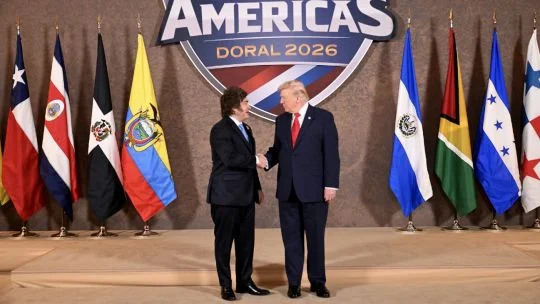
Donald Trump’s relationships with world leaders can be personal and transactional. But his Republican Party has long supported the IMF’s fiscal discipline and market-friendly “Washington Consensus” policies, and tends to align with right-wing parties on immigration and security. That makes the lender-government convergence politically significant, even if the officials avoid framing it that way.

New governments turn to familiar lenders
Argentina’s Javier Milei has become the region’s conservative standard-bearer, with a chainsaw serving as the emblem of his austerity drive. Last year, the country received a US$20 billion IMF package, including an unusual US$12 billion disbursement upfront, despite objections from some Fund board members. This week, Managing Director Kristalina Georgieva appeared alongside Economy Minister Luis Caputo and presented Argentina as a model.
Other governments are also seeking support. Chilean President José Antonio Kast, a market-friendly reformist, received a renewed flexible credit line from the IMF in August. Colombia’s Abelardo de la Espriella took office that month and is negotiating a programme to address the fiscal damage left by his predecessor. Bolivia’s Rodrigo Paz ended nearly two decades of socialist rule last year and secured a US$1.9 billion programme earlier this month, as the country confronts its worst economic crisis in 40 years. His government is cutting fuel subsidies and trying to repair public finances weakened by falling natural-gas revenues and shortages of dollars.
Bolivia’s Finance Minister Christian Andrés Morales said new opportunities were opening for the region and that governments needed to approach them responsibly. Chalk said he sensed stronger regional backing for both the IMF and multilateral institutions more broadly. That support marks a change from earlier left-wing governments, which often blamed the Fund and other lenders for imposing fiscal restraint.


The World Bank expands its reach
The World Bank is widening its involvement too. Cordeiro Guerra said it wants to reward governments that carry out reforms, including fiscal consolidation and steps toward macroeconomic stability. She cited Paraguay, the Dominican Republic, El Salvador and Panama as countries combining private-sector-friendly policies with annual growth above four percent.
Venezuela could receive as much as US$5 billion in World Bank loans over the next two years, provided it clears arrears with other multilateral lenders. The country had not received a bank loan since 2005. It restored formal ties with the Washington-based lender earlier this year, after the United States captured former president Nicolás Maduro. This week’s meetings were the first in more than two decades to include Venezuelan officials. Economy Vice-President Calixto Ortega appeared at an event with Chalk.
The bank is also preparing lending packages for Colombia, Barbados and Argentina. The proposals still need executive board approval and would draw on the bank’s public and private-sector arms. Argentina is facing more than US$25 billion in debt maturities. Colombia’s proposed package includes three loans covering spending efficiency, energy and health, though Cordeiro Guerra did not give their size. Barbados could receive financing for payment regulation and digital government payments.
Some of the funding may use a structure already applied in Argentina: the World Bank backed a commercial loan of up to US$2 billion, using guarantees to reduce risks for private creditors and help the government borrow on better terms. For countries squeezed by debt and weak public finances, that model could broaden access to capital. The scale and terms of the proposed packages, however, will depend on board approval.


By Manuela Tobias and Jorgelina do Rosario, Bloomberg
In this news
Personalities: Javier Milei, Donald Trump, Nigel Chalk, Susana Cordeiro Guerra, Christian Andrés Morales and Calixto Ortega.
Topics: Economy, World, Latin America, Trump Administration, Washington, United States, IMF, World Bank, International Monetary Fund and Washington Consensus.
Discussion
Sign in to join the discussion.