Without national data or tailored support, people with albinism in Pakistan face barriers in classrooms, healthcare and work.
Pakistan’s systems for education, healthcare and disability support have little visibility into the needs of people with albinism. That gap is felt in ordinary decisions: whether a student gets extra time in an exam, whether a family can afford sun protection, and whether an employer sees a candidate’s qualifications before their appearance.
For Adeel Nasir, 24, of Kot Radha Kishan in Punjab’s Kasur district, the consequences began in school. His low vision made it difficult to read classroom whiteboards. Some teachers moved him closer, improved the lighting or provided written notes. But when he asked what qualifications were needed to become a fighter pilot, one teacher replied, “First of all, you should be able to see clearly with your eyes.” Classmates laughed.
Years later, Nasir says people still notice his condition before his abilities. “My abilities, my degrees, and my skills were ignored because of my weak eyesight and physical appearance,” he told Global Voices.
Uncounted in national data
Pakistan has no separate national estimate of its population with albinism. The country’s 2023 Population and Housing Census asked about functional difficulties—including seeing, hearing, walking, communicating, remembering and caring for oneself—but did not record individual conditions. A Pakistan Bureau of Statistics representative told Global Voices that the bureau keeps no separate official data on albinism. Collecting information about rare conditions, the representative said, requires a carefully designed questionnaire and a decision about the most suitable method.
That distinction matters. Nasir eventually obtained a disability certificate, but it was issued because of his low vision. “The disability certificate we received is also issued on the basis of our weak eyesight, not because of albinism itself,” he said. He added that government offices have no separate form or category where people can register as having albinism.
Albinism is a rare, inherited, non-contagious condition involving reduced or absent production of melanin, the pigment that gives colour to skin, hair and eyes. Low melanin can contribute to visual impairment and greater vulnerability to ultraviolet radiation. The condition does not affect a person’s intellectual ability.
Researchers have documented albinism in Pakistani families, even though no national count exists. One study examined 94 previously unreported Pakistani families with non-syndromic oculocutaneous albinism and found disease-causing variants mainly in the TYR and OCA2 genes. Such family studies establish that the condition is present; they cannot show how many people in Pakistan have it.
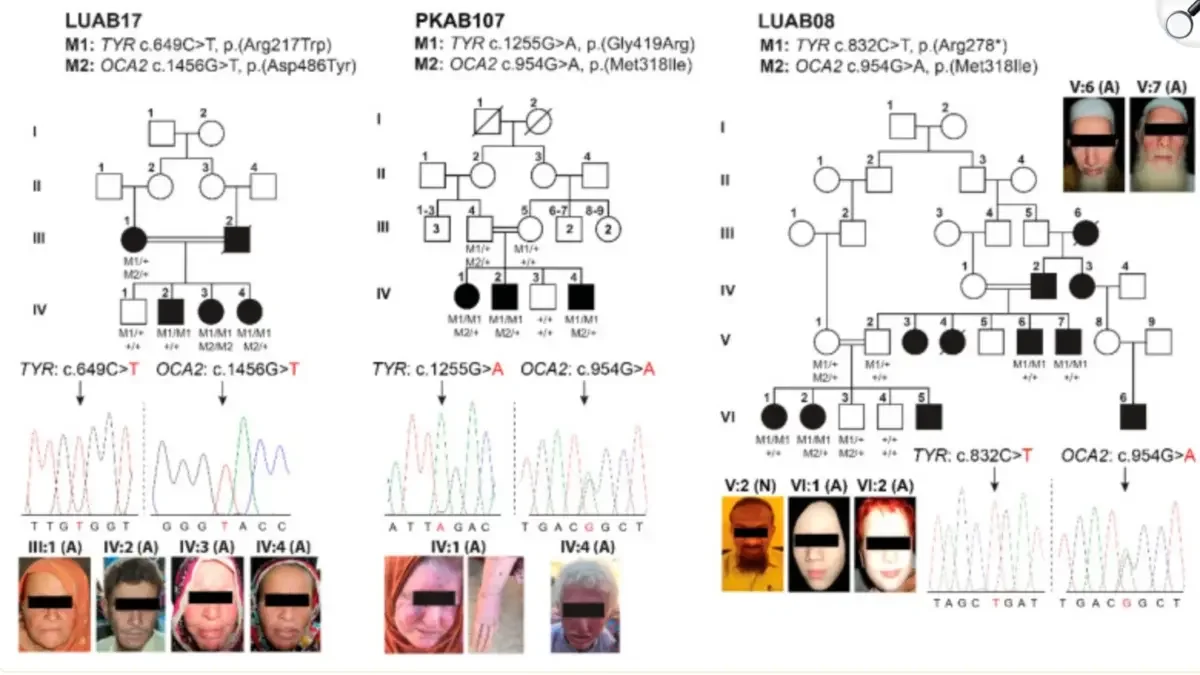
Graph from the 2021 study “Genetic Causes of Oculocutaneous Albinism in Pakistani Population.” Sajid et al., Genes 2021, 12(4), 492. CC BY 4.0 via MDPI.
Global estimates are limited too. The UN says country-level statistics on albinism are scarce worldwide. Available estimates suggest a prevalence of roughly one in 17,000 to 20,000 people in many European and North American populations, with higher rates in some African communities. Those figures cannot substitute for Pakistani data or guide services for communities within the country.
Asim Zafar, a disability rights advocate, put the planning problem plainly: “Data is very important for any country because planning is done on the basis of data, and budget allocation is done on the basis of planning.” During a June 2026 visit to Pakistan, UN Independent Expert on the enjoyment of human rights by persons with albinism Malooka-Anne Miti-Drummond said gaps in data and policy leave needs overlooked. “When communities are not visible, their needs are not visible.”
School adjustments depend on self-advocacy
For Sundus Arif, 39, who grew up in Lahore, the recurring challenge has been making others understand what she needs. Her schools had no structured accommodations for students with albinism, so she had to ask for practical changes herself: sitting in the shade during outdoor assemblies, using larger print and getting more time to copy material from the board.
“There are neither clear guidelines nor effective arrangements in educational institutions of Pakistan to accommodate students with albinism,” she told Global Voices. Nasir said that some classroom adjustments helped him remain in school, but he was not given extra time during examinations despite his visual difficulties.
Miti-Drummond has warned that bullying and inadequate support can undermine children’s confidence and schooling. “If a child is bullied, they are more likely to drop out of school.” The examples from Arif and Nasir suggest that accommodations often depend on an individual student’s ability to explain and negotiate their needs, rather than clear arrangements within schools.
Healthcare costs shape daily choices
Low melanin increases vulnerability to sun damage, making sun protection and regular skin and eye care important. The World Health Organization says early eye care, sun protection and access to health information can reduce many complications associated with albinism. Yet access to sunscreen, sunglasses and specialist care can depend on household income.
Arif, who is also a parent of a child with albinism, said sunscreen and sunglasses help protect children’s skin and eyes. Miti-Drummond described the trade-off faced by families with limited resources: “If you have to choose between sunscreen and buying food, and you are already struggling to buy food, this is something that becomes inaccessible.”
Pakistan’s rising temperatures and frequent heatwaves add another pressure. A study in BMJ Global Health reported that climate change may increase risks for people with albinism through greater exposure and obstacles to preventive healthcare in low-resource settings. Nasir says sensitivity to sunlight makes it difficult to get around outdoors, and he has experienced problems with his skin and eyesight.
Qualifications do not guarantee access to work
Nasir says employment became one of his biggest challenges after completing his education. He believes employers focused on his eyesight and appearance rather than his qualifications. Miti-Drummond has described similar discrimination internationally: “You may be very well qualified, but actually getting employment, there was still stigma and discrimination.”
Arif says women with albinism can face additional scrutiny tied to appearance, marriage and expectations of femininity. In her experience, people judged how she looked before considering her education, professional abilities or personality. That pressure sits alongside the barriers associated with low vision and limited accommodations.
Recognition has to reach implementation
Miti-Drummond pointed to frameworks and initiatives in Malawi, Cameroon, Tanzania, Mozambique, Uganda, Angola and Panama that have supported awareness, healthcare access, education and protection from discrimination. For Pakistan, advocates say better information is an essential starting point, but official recognition needs to translate into practical support.
Zafar cautioned that formal rules alone do not ensure access: “Policies are available, laws have been made, but there is a lack of implementation.” For people with albinism, that can mean repeatedly asking schools, employers and public institutions for arrangements that could be built into routine practice.
Pakistan’s lack of a national estimate makes it harder to plan services around the community’s needs. Counting people with albinism would help inform decisions on education, healthcare, social protection and climate-sensitive planning. The next step is ensuring people with albinism have a voice in those decisions. As Miti-Drummond put it: “Nothing for us without us.”
Discussion
Sign in to join the discussion.