Anduril Industries plans a $6.6 billion investment in submarine manufacturing to address US Navy production gaps amidst rising competition from China.
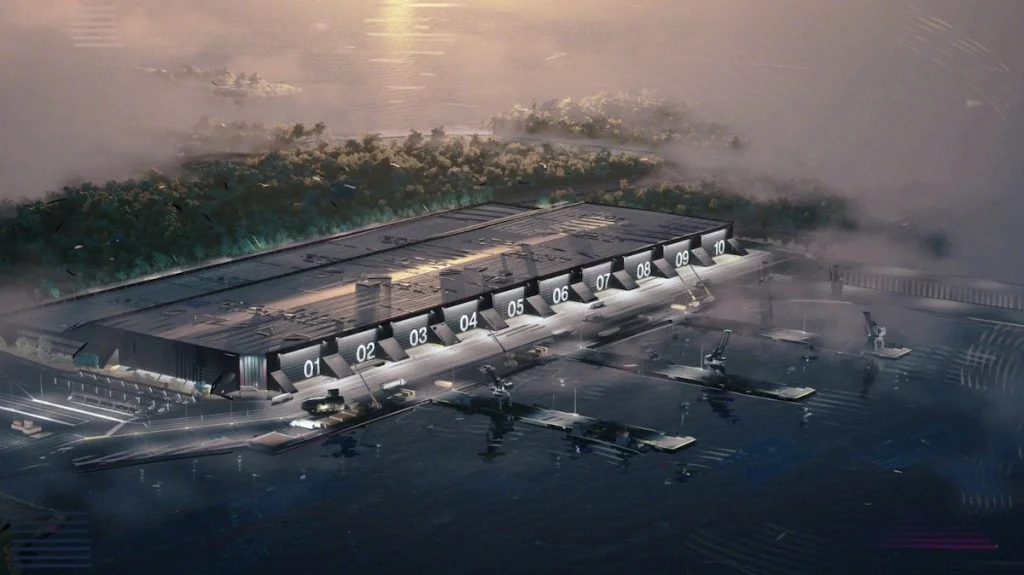
A significant move is underway as Anduril Industries announces plans to invest $6.6 billion in revitalizing the US submarine manufacturing capacity. This initiative aims to mitigate severe production bottlenecks in the Navy's Virginia-class nuclear attack submarine program, especially as tensions in the Indo-Pacific grow due to China's expanding naval capabilities.
This venture involves the construction of a 2-million-square-foot facility, referred to as a "software-defined shipyard," in Sparrows Point, Maryland. The project, which includes a $3.7 billion investment by Anduril and a complementary $2.9 billion contract with the US Navy, will create 3,100 direct manufacturing jobs and enhance submarine production output by an estimated 15%. Crucially, the facility is designed to streamline workflows with innovative digital tracking and features such as a 1,200-foot graving dock and direct rail access.
Timetable for the facility suggests that operations will commence by 2030, with critical components such as torpedo tubes expected to be delivered from an existing facility in Costa Mesa, California by 2028. This step is critical in addressing immediate operational needs while the Maryland plant ramps up production to meet both domestic fleet demands and commitments under the AUKUS security pact for Australia.
Current US submarine production struggles to meet navy requirements, with historical averages at just 1.1 to 1.2 submarines per year since 2022. The US Navy aims to increase this number to two submarines annually, ultimately targeting 2.33 boats per year to reduce backlogs and meet defense commitments. With China's rapid modernization of its submarine fleet—a projected increase to over 80 submarines by 2035—this expansion of US capabilities is viewed as critical to maintaining a competitive edge.
The urgency of this initiative is underscored by a recent report from the Congressional Research Service (CRS), which highlights that while the Navy seeks to achieve a fleet goal of 66 nuclear submarines, it has yet to consistently reach this target. Ongoing delays in construction are attributed to workforce shortages, supplier issues, and component delays, raising questions about the US's ability to sustain its undersea warfare capabilities in the face of increasing competition.
In operational contexts, US submarines have been actively engaged in the Western Pacific, underpinning critical strategic deterrence against China. Reports indicate that the US had at least 11 nuclear-powered submarines deployed across key operational corridors in the region as of June 2026, emphasizing the strategic importance of their undersea presence, particularly in light of potential conflicts over Taiwan.
Expert analysis reveals that US submarines hold a significant operational advantage in undersea warfare, especially against weaknesses in China's anti-submarine warfare (ASW) capacities. Simulated conflict scenarios depict SSNs playing essential roles in targeting Chinese amphibious forces, protecting key logistical channels, and screening against Chinese submarine incursions into broader operational theaters.
Yet, the landscape of undersea warfare is evolving, with Rear Admiral Mike Brookes emphasizing the shift towards a networked approach to ASW from China. This strategy uses integrated systems of aerial, surface, and undersea sensors to control vital maritime routes and minimize detection risks for Chinese vessels. As China redefines its tactical frameworks under the “Near Seas Defense, Far Seas Protection” doctrine, the resultant growth in its submarine fleet, projected to reach around 70 units by 2027, poses an ongoing challenge to US naval superiority.
While the scale of China’s submarine fleet continues to expand with significant state investment and modernization of shipbuilding capabilities, there are still factors constraining its qualitative edge. Analysts point to ongoing challenges in areas such as acoustic quieting and advanced fuel-cell propulsion, which may leave some Chinese submarines vulnerable to allied sonar detection. However, rapid advancements in their submarine designs, including the recent unveiling of the Type 09V SSN, underline the potential for qualitative leaps that could complicate US strategic planning.
The strategic stakes are increasingly high, and whether the new investment in US submarine production can deliver on its promise before the projected operational shifts of the 2030s will prove vital. The need to counter China's dense sensor grids and innovative submarine designs becomes paramount in safeguarding the US's deterrent capabilities in the region.
Ultimately, the success of this initiative might determine if the US can successfully uphold its undersea margin or if the evolving dynamics related to China's naval capabilities turn the Western Pacific into a challenging operational environment for American maritime forces.
Discussion
Sign in to join the discussion.