China is advancing its naval capabilities with a dedicated drone mothership for underwater reconnaissance, redefining its military strategy across multiple domains.
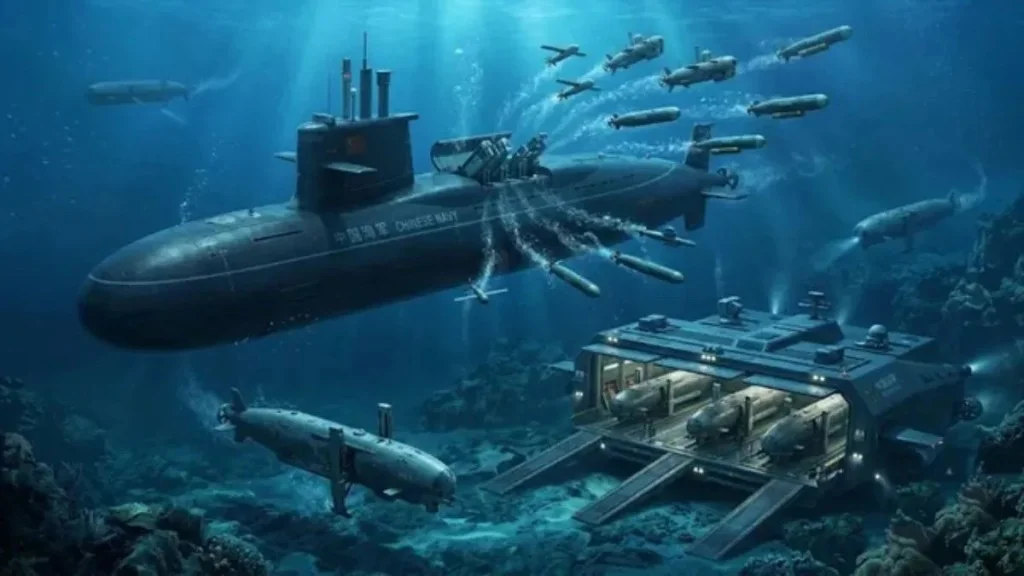
China is in the process of building a specialized mothership dedicated to extra-extra-large uncrewed underwater vehicles (XXLUUVs) at the Hudong-Zhonghua shipyard in Shanghai, as indicated by various sources. The vessel, measuring approximately 200 meters, showcases a significant design with a spacious internal hangar capable of accommodating up to four autonomous submarines along with an open-bottom stern well-deck engineered for direct sea deployments.
This platform is engineered to function as both a mobile support base and maintenance tender, offering logistical advantages that will enable China’s extensive underwater drones—measuring between 35 and 45 meters—to operate far beyond the country's coastal boundaries. Such capabilities could enhance reconnaissance and strike operations across critical maritime chokepoints.
Despite the strategic advantages this mothership affords, analysts express concerns about its size making it a prime target in potential conflicts. The large surface area could lead to higher radar and thermal signatures, thus compromising the stealth aspect vital for underwater operations. In the midst of ongoing tensions in the region, the potential deployment of XXLUUVs is seen as a significant military move during conflicts, such as a potential Taiwan scenario, where these assets could be used for intelligence-gathering, mine-laying, and attacking enemy vessels.
Interestingly, the move follows China’s recent testing of the Jiutian drone carrier, which is designed to release swarms of loitering munitions against Taiwan’s air defenses. This new mothership concept aligns well with other developments in China’s naval strategy, such as the Type 076 amphibious assault ship that is capable of launching uncrewed combat aerial vehicles.
Strategic Concerns and Operational Trade-offs
Military experts note that the introduction of surface motherships offers a harsh operational trade-off; while these vessels enhance logistical endurance, they sacrifice stealth. The suggestion is that the presence of such large ships in contested waters could easily reveal their positions, effectively converting these tactical assets into high-value targets amidst confrontation.
Despite potential vulnerabilities, the simultaneous development of the Jiutian aerial carrier, the Type 076, and the new XXLUUV mothership illustrates a clear shift towards a coordinated, multidomain approach to warfare. China appears to be straddling two operational concepts: Multidomain Precision Warfare and Systems Destruction Warfare, both designed to disrupt opposing capabilities.
The Multidomain Warfare Concept
Multidomain Precision Warfare leverages advances in artificial intelligence and machine learning to synchronize data across various military domains. It entails coordinated strikes that encapsulate cyberattacks, electronic warfare, and the deployment of unmanned systems, all aimed at dismantling an adversary’s operational integrity.
This doctrine speaks to a more strategic vision that prioritizes undermining an opponent’s essential networks rather than merely defeating individual units. This aligns with a RAND report suggesting China’s approach focuses on systemic paralysis of adversaries by targeting critical communication and information infrastructures, rather than expecting straightforward attrition victories.
Feasibility and Challenges Ahead
However, the practical execution of these multidomain concepts raises questions. Scholars like Christian Wirth argue that the stringent centralization of command in China might hinder rapid, flexible decision-making required for effective multidomain operations. His assessments suggest that the rigidity influenced by political hierarchies can stymie adaptive military strategies in fluid battlefield scenarios.
Conversely, others maintain that China’s approach is oriented uniquely towards countering US strategies, thereby providing an actionable framework for military engagement. They argue that cohesive political-military integration offers China an advantage in maintaining operational clarity that might elude Western forces.
Ultimately, while China’s developments in drone motherships and its academic focus on autonomous drone swarms underscore an evolving military strategy, the empirical effectiveness of these high-tech systems remains largely untested in real combat scenarios. Engaging with well-coordinated adversaries will be a crucial test of the feasibility of these advanced concepts in multidomain warfare.
Thus, as China pushes the boundaries of its military capabilities, the international community remains watchful for the implications such advancements may have on global security dynamics and regional stability.
Discussion
Sign in to join the discussion.