Javier Milei's economic strategies are sparking concern as Argentina's industrial sector struggles with rising unemployment and competition from imports.
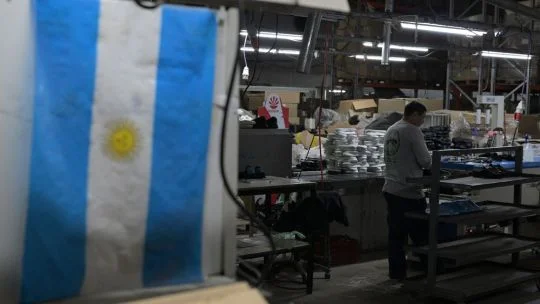
The Kioshi footwear factory, once employing 120 people, now operates with a mere 14 staff members, encapsulating the dire state of Argentina's industrial landscape. As unemployment rises and factories shutter, the ongoing debate regarding President Javier Milei's economic policies intensifies. While Milei touts decreasing inflation and deregulation as successes, many in the business community lament job losses and a faltering domestic market.
Emmanuel Fernández, director of Kioshi, underscores the severity of the crisis, stating, “The domestic market is dead. People don’t have money to spend, so they’re hardly going to buy shoes.” He emphasizes that a surge in imports further exacerbates the situation, making it nearly impossible for local manufacturers to compete.
On the heels of alarming job losses, with estimates indicating around 90,000 positions vanishing since August 2023, the Argentine Industrial Union (UIA) has called for immediate action to address the economic realities. At the outset of June, approximately 40 percent of the industrial sector's production capacity was sitting idle, and the manufacturing sector recorded its worst decline in 16 months with a 5% drop in output between June and July.
Despite these figures, Milei remains steadfast, declaring during a recent address that his government's austerity measures and deregulation policies are “non-negotiable.” In stark contrast, industry leaders argue that Milei’s approach is not only harmful but fails to recognize the complexities of Argentine economic dynamics.
Since his administration began in December 2023, more than 30,000 businesses have closed their doors, according to industry reports. The President insists that while jobs may be lost in traditional sectors, new opportunities will arise in industries that can engage on a global scale. However, this sentiment is met with skepticism from many, including Fernández, who feels the government’s outlook is detached from the on-the-ground realities facing workers.
The Transition from Manufacturing to Gig Economy
In Zárate, an industrial town situated 90 kilometers from Buenos Aires, former Clariant employee Miguel Márquez reflects on the fallout from the factory's closure in 2025. After two decades, he and 41 colleagues were left jobless, with only two successfully finding formal employment. At 62, Márquez now survives through informal work, including driving for Uber.
The economic environment, particularly the unrestricted influx of imports, has compelled Clariant to source products from Brazil rather than sustaining local production that once thrived on the oil industry’s boom linked to Vaca Muerta shale. “Since they have no restrictions whatsoever, it makes more sense for them to bring them in from Brazil,” he notes, highlighting the stark reality of competition for local workers and businesses.
Despite some growth in Argentina's economy driven by resources like hydrocarbons and agriculture, the situation remains dire for commerce and industry, especially as urban centers bear the brunt of job cuts. Research indicates that from 2023, over 240,000 salaried positions in the private sector have been lost, presenting a bleak picture for the nation's workers.
Uneven Playing Fields and Consumer Demand
In response to the UIA’s plea for intervention, Economy Minister Luis Caputo asserted that his focus lies not with specific companies but with the wider interests of 48 million Argentines. He characterized it as “immoral and unfair” for consumers to pay exorbitant prices for inferior goods when more competitive options exist abroad.
However, industrialists argue the market conditions are lopsided. Alejandro Mayer, vice president of circuit manufacturing firm Ernesto Mayer, points out that half of the company's machinery now stands silent. He criticizes an overvalued currency and astronomical interest rates that hinder domestic production's ability to compete on price against imports from countries like China.
While Milei’s administration has managed to reduce the previously skyrocketing inflation rate to 33.8 percent year-on-year as of July, industry figures contend that inflation shouldn't be the sole metric for economic success. UIA President Martín Rappallini advocates for a more comprehensive appraisal that includes overall economic activity and the health of the industrial sector.
The palpable decline in consumer demand is also concerning. For example, small operations like that of Martin Blust, who produces musical instrument strings and employs just ten people, have resorted to shutting down Friday operations due to lack of orders. “There is no inflation because there are no purchases,” asserts Gloria Aparicio, Blust's partner.
As job security becomes the primary concern for many Argentines, there’s rising anxiety echoed by employees like those at Kioshi, who increasingly seek salary advances merely to manage transportation costs to work. “They’re frustrated and angry,” Fernández reflects, citing a pervasive sense of discontent that only intensifies amid economic uncertainty.
This climate, marked by diminishing prospects and mounting challenges, offers a candid look into the evolving economic reality of Argentina. If things do not shift soon, the stakes could rise significantly ahead of the 2027 elections, with the Argentine populace's patience wearing thin.
Discussion
Sign in to join the discussion.