Leo XIV’s visit to Argentina brings a long-awaited papal return as the country weighs Francis’s absence, political divisions and economic strain.
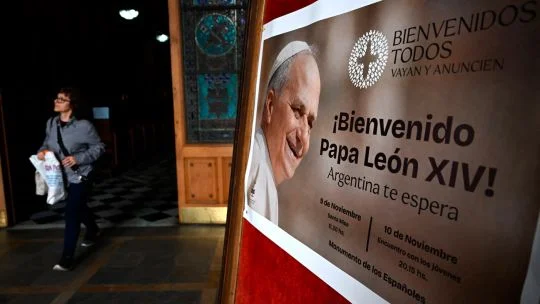
Pope Leo XIV’s visit to Argentina carries a significance that reaches beyond the itinerary: it gives the country the papal homecoming it never received from Francis. The first visit by a pope in 39 years comes as Argentines weigh the memory of their most famous compatriot against a new pontiff who has his own long-standing ties to Latin America.
A visit shaped by Francis’s absence
At Buenos Aires Metropolitan Cathedral, where Jorge Bergoglio served as archbishop for 15 years, a screen shows footage of Francis kissing the feet of worshippers. Nearby, a poster promotes the open-air Mass Leo will celebrate next Monday, during the second leg of his South American tour.
For 23-year-old Sol Burgos, the new pope’s arrival offers comfort after Francis never returned to his homeland as pontiff. “Argentina was deeply hurt to lose its pope,” she said outside the cathedral. Leo’s years as a missionary and later archbishop in Peru, she added, have made his connection to the region familiar: “Thank God the new pope has also had a connection with Latin America!”
Francis visited several Latin American countries, including neighbouring Brazil, during his 12 years leading the Catholic Church. His decision to skip Argentina left a question that still shapes the reception awaiting Leo.
Why Francis stayed away
The common explanation is that Francis worried a homecoming could be read as support for the Peronist movement, which governed for much of his papacy. That concern took on new weight as Argentina’s political climate shifted, culminating in Javier Milei’s 2023 election victory.
“He couldn't or didn't want to come,” said Ruben Lozano, 73, who travelled from Santa Fe Province to the capital. Lozano believes Francis chose distance to avoid inflaming divisions. Milei, who had sharply criticised Francis before becoming president over the pope’s remarks on capitalism and his perceived left-wing positions, has offered a similar interpretation. “I have no doubt that Pope Francis wanted to come, and I think he didn't come because he knew that if he did, it would cause a political earthquake,” he told Radio Mitre last month.
Francis addressed the boundary between church leadership and politics in a book-length interview published in 2023. He said the papacy had a political dimension, while distinguishing that role from party politics. The explanation has not settled the debate over what kept him from Argentina.
Leo’s itinerary and the call for reconciliation
Leo is due to arrive from Uruguay on Sunday, with Milei set to greet him at the foot of his plane. After the large outdoor Mass in Buenos Aires, the pope will travel to Córdoba and to the Basilica of Luján, near the capital. The shrine draws millions of pilgrims each year. John Paul II was the last pope to visit Argentina, in 1987.
Jorge García Cuerva, the current archbishop of Buenos Aires, has cautioned against treating Leo as a stand-in for Francis. “The successor of Peter [regarded as the first pope] is coming, not the successor of Francis,” he said in August.
Still, García Cuerva sees the visit as a chance to ease tensions between rich and poor and between left and right. “The wound that exists amongst Argentines can heal, through the gentleness of tenderness, kindness, cordiality and forgiveness,” he recently told La Nación.
A pastoral message amid economic strain
That appeal lands in a country under pressure. Energy growth contrasts with weakness in industry and consumer spending, while poverty affects a third of the population. Milei has maintained strict fiscal austerity and economic liberalisation after three years of painful cuts, presenting them as a response to overspending and runaway inflation.
The Church has strongly criticised the cost of Milei’s budget cuts and deregulation for poor Argentines. Leo, like Francis, has placed the poor and marginalised near the centre of his papacy. Lozano sees continuity between them, describing Leo as “a sort of continuation...of the imprint that Francis left on the Vatican and the Church.”
Leo’s visit won’t resolve Argentina’s political and economic fractures. Its test may be more modest: whether a pope with regional roots can make a long-delayed return feel like an opening for shared ground, rather than another occasion to revisit old divisions.
Discussion
Sign in to join the discussion.